

VARS Launches the New CleveRA EVO. It Will See Czech Motorways in Greater Detail Than Ever Before
The new CleveRA Car EVO delivers higher resolution and scanning frequency, enabling more accurate detection of micro-defects. Diagnostic data helps us prioritise repairs based on the actual condition of road surfaces, confirms the Czech Road and Motorway Directorate.
VARS is expanding its technological capabilities for road infrastructure diagnostics with the introduction of the new, more advanced CleveRA Car EVO. Building on an established and proven solution, the new vehicle further enhances the collection and evaluation of road condition data.
Over the past four years, diagnostic data has been collected across more than 121,000 kilometres of roads. CleveRA Car EVO takes this data collection to a new level, enabling even more accurate planning of repairs and infrastructure investments.

“The new vehicle is based on the same technical platform as the existing system, the Mercedes-Benz Sprinter, and retains the proven integration platform supplied by Ramboll, one of the world leaders in mobile mapping. The main advances lie in its sensor technology, measurement accuracy and overall operational efficiency. Modern diagnostics make it possible to repair roads based on their actual technical condition rather than simply their age or a visual assessment.”
Ing. Tomáš Miniberger
CEO and Chairman of the Board, VARS
The new-generation CleveRA Car is equipped with upgraded sensors offering higher resolution, greater dynamic range and lower noise levels. This allows it to capture an even more detailed picture of road surface conditions, including micro-defects that are critical for timely maintenance planning. The improvements also extend to everyday operation. Measurements can now be carried out continuously at speeds of up to 100 km/h, contributing to greater safety while minimising disruption to traffic.
“Another major technological advancement is the introduction of the new generation of the LCMS-2, or Laser Crack Measurement System, which enables more accurate detection of cracks and other types of road damage. Combined with advanced analytics and machine learning, it allows individual types of damage to be classified and quantified faster and more accurately,” says Zdeněk Drápela from VARS.
The new CleveRA Car is also equipped with an improved imaging system. Allied Vision planar cameras provide higher-quality recordings even under challenging lighting conditions, while two LadyBug panoramic cameras enable the capture of georeferenced images of the surrounding road environment. These outputs create opportunities for further use of the data, including infrastructure inventories, asset management and the creation of 3D infrastructure models. More accurate positioning is provided by a new GNSS IMU unit, which uses multiple satellite navigation systems and reduces the time required to initialise measurements.
“The result is greater absolute accuracy of positional data, which is essential for long-term monitoring of changes in road condition. The upgrade also includes new data servers that meet current technological standards and security requirements. They enable faster processing of large volumes of data and more efficient integration with analytical tools,” says Zdeněk Drápela.
The Detail That Makes the Difference
The LCMS provides up to 100 times higher resolution, making it possible to detect even microscopic changes in the road surface, including fine cracks, emerging deformations and changes in texture that are almost invisible to the naked eye. These small deviations often serve as the first warning signs of future deterioration.
The New CleveRA Car EVO
The LCMS provides up to 100 times higher resolution
The new, more advanced CleveRA Car can detect micro-defects in road surfaces more effectively. Diagnostic data helps determine repair priorities based on the actual condition of roads. The LCMS offers up to 100 times higher resolution, allowing it to identify even microscopic changes in the road surface, such as fine cracks, emerging deformations or changes in texture that are virtually invisible during conventional visual inspections.
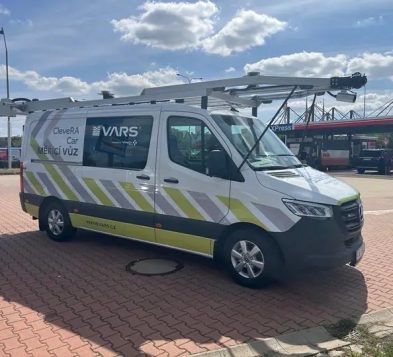
When combined with artificial intelligence, the value of this data increases even further. CleveRA software automatically analyses vast amounts of information, detects defects that conventional mobile mapping systems may miss, and evaluates both their severity and development over time. The result is an exceptionally accurate and objective picture of road conditions. This makes it possible to plan maintenance in a targeted and efficient manner and sufficiently far in advance, before minor defects develop into costly repairs.
Savings That Make Economic Sense
The CleveRA solution forms part of a Pavement Management System (PMS). According to studies, PMS solutions can deliver savings of between 20 and 40 percent for road authorities by enabling a shift from reactive maintenance to planned maintenance.
“The largest share of these savings comes from reducing emergency repairs, which are several times more expensive than timely preventive interventions. Additional savings result from extending pavement service life, improving investment planning, allocating budgets more effectively and reducing the number of interventions required in the field,” says Tomáš Miniberger. He adds: “What matters most, however, is scale and continuity. If these systems are not operated over the long term, on a sufficiently large scale and according to a certified methodology, they risk becoming a waste of public funds rather than a genuine source of savings.”
“The new vehicle introduces technology that is particularly important for diagnosing cement concrete motorway pavements. It allows us to assess road surface conditions in detail, including the detection and evaluation of microcracks in cement concrete pavement. The data obtained enables us to determine the current condition of the road more accurately and identify the optimal time for maintenance or intervention, both within the road condition management system and within the system used to assess the condition of cement concrete pavements,” says Jiří Hlavatý, Director of the Construction Quality Control Division at the Czech Road and Motorway Directorate.
An Ecosystem as a Competitive Advantage
The key competitive advantage of the CleveRA solution is not simply the measuring vehicle or the software itself. It is the entire ecosystem: a combination of technology, analytical tools and a team of experts responsible for ensuring the methodology, data quality and correct interpretation of results. This integrated approach makes it possible to transform technical data into sustainable, economically rational long-term decisions. Technology alone cannot repair roads. Infrastructure management only delivers its full value when it is supported by a systematic, certified, long-term approach and a sufficiently large volume of high-quality data.
Selected Statistics and Data from CleveRA Car Measurements to Date:
- Modern diagnostics make it possible to repair roads based on their actual technical condition, rather than simply on the age of the road surface or a visual assessment.
- Over the past four years (2023 to July 2026), we have diagnostically surveyed 121,489 km of roads and motorways. That is approximately three times the circumference of the Earth at the equator, or more than 1,500 return journeys between Prague and Brno.
- For the Czech Road and Motorway Directorate (ŘSD), the largest user of modern road diagnostics in the Czech Republic, we surveyed 63,050 km of motorways and 8,710 km of Class I roads between 2023 and July 2026. That is approximately 72,000 kilometres in total.
- Diagnostic data supports not only ŘSD in managing motorways and Class I roads, but increasingly also regional authorities. For example, more than 22,000 kilometres of Class II and III roads have been surveyed in the Central Bohemian Region in recent years, demonstrating that data-driven maintenance management is gradually becoming standard practice at regional level as well.
- More data means better decision-making on investments worth billions. The annual volume of measurements increased from 24,550 km in 2023 to almost 40,000 km in 2026.
- CleveRA Car EVO builds on the most extensive experience in road condition measurement in the Czech Republic. It is backed by data from 63,000 km of variable-parameter measurements on motorways and Class I roads over the past four years alone, as well as almost 50,000 km of regional and state roads measured during the same period.
Take a Closer Look at CleveRA Car EVO
The new generation of VARS BRNO’s road infrastructure diagnostic vehicle.
Photos for Download
Press-quality photographs of the CleveRA Car EVO vehicle are available in the VARS BRNO press centre.